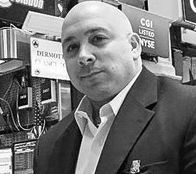
In his younger days, Chris Bonanno was an active and athletic person who worked on Wall Street, ran a nightclub, and was a walk-on for his college cross country team. All of that changed with the discovery of a spinal cord tumor. The eventual surgery to remove it ultimately left Chris paralyzed from the chest down.
Chris, now 52, started experiencing back problems when he was in college. “I’ll never forget when it all began,” he says. “I was training for a 5K and after my run, I limped off the track. Soon after, I was involved in a head-on car collision. I was taken to the hospital, and an MRI revealed a tumor in my spinal cord.”
He underwent an initial, exploratory surgery to determine the nature of the tumor and for a biopsy. “Thankfully, it was non-cancerous, but I still underwent radiation treatments to shrink it without trying to remove it,” he says.
For the first few years, this approach seemed to work. “However, about three to four years later, I began having trouble walking again,” Chris says. “After a thorough examination, doctors found that the tumor had started growing again. They attempted to insert a shunt to drain it, but the procedure was unsuccessful.”
By 2000, the tumor had progressed to the point where he could barely walk a few steps before needing to rest. “The doctors in Atlanta weren’t making any progress, so I did extensive research and reached out to Dr. Fred Epstein, a specialist in removing tumors from children.”
Epstein was known as a pioneer in the field, Chris says. “I emailed him, and to my surprise he called me within 20 minutes,” he says. “He asked for my latest films, which were overnighted from my doctors in Atlanta. A few days later, he called back to say he could remove the tumor.”
While the surgery was risky, the surgeon explained that if left untreated, the tumor would eventually crush his spine or block it completely, “which could be fatal or leave me paralyzed,” he says.
“Dr. Epstein gave me a 50% chance of walking again after the surgery,” Chris says. He traveled to New York and had the surgery at Beth Israel hospital. When he woke up, he was paralyzed from the chest down.
“Although it seemed grim, I refused to give up,” Chris says. “I accepted the challenge and resolved to walk again.”
After spending three weeks recovering at Beth Israel, he flew home to Atlanta with the help of his parents and was admitted to Emory University’s inpatient rehab, where he spent about two months working on recovery.
“I will never forget my first day there,” Chris says. “The nurse handed me a large book about living in a wheelchair. I was so frustrated that I flung it at the door as she left. But by the time I finished my rehab at Emory, I could move my legs and use hand crutches.”
His next stop was Shephard Spinal Clinic in Atlanta, where he was an outpatient for several months. “It was at Shepherd where I made my biggest strides but also realized that many others were in worse situations than me,” Chris says. “I worked out in their gym every morning, and by the time I left, I was able to walk with just one hand crutch. I felt independent again.”
Over the next few years, Chris gradually shed the crutches and regained the full use of his legs.
“I attribute much of this progress to the workouts I did and to going back to work at the nightclub I had started at in college,” he says. “I had gone from deejay to bartender, and standing for six hours a night was like a workout. Some nights, after my shift ended around 2 or 3 a.m., I would go straight to the gym. I was always determined to improve my situation.”
Chris also launched an event tickets business called Stubshack tickets. Through the service, he sells tickets to sold-out events all over the world.
After many years of training, physical therapy sessions, and doing research about how to better his situation, Chris found out about a product called the L300 Go from Bioness Medical. The system uses functional electrical stimulation to help correct foot drop and thigh weakness in people coping with the effects of stroke, multiple sclerosis, and other medical conditions.
“After starting to use the device, I saw significant improvement in my ability to walk,” Chris says. The product has had a remarkable impact on his mobility, allowing him for the first time in decades to walk up his driveway with his dog Storm and regain a newfound sense of independence in his daily life.
Despite the enormous challenges Chris has faced, his determination drove him to work intensively on his rehabilitation. Over the past two decades, he has worked tirelessly to rebuild his life.
“I’m grateful for many things—many of which most people take for granted every day,” Chris says. “I still work out regularly, always looking for ways to make walking easier. People often stop me to express sympathy, but I correct them, saying, ‘It’s okay’. There are days when I wish others could experience a day in my life. It would make them appreciate life more and not get caught up in the small things.”
“If you can’t fly then run, if you can’t run then walk, if you can’t walk then crawl, but whatever you do you have to keep moving forward.”—Martin Luther King Jr.
If you haven’t subscribed, you’re missing out on post updates! To sign up, type your email in the box below then click on the green subscribe button. When you receive a confirmation message from WordPress, click on the “confirm now” button to complete the process.


Leave a Reply